

Marketing automation best practices increase ROI when they cut busywork, sharpen targeting, and move prospects forward without adding friction. The best teams do not automate everything at once. They start with clear goals, clean data, and one workflow tied to revenue.
That discipline pays off. Updated industry benchmarks still point to an average return of about $5.44 for every dollar spent on marketing automation, and many teams recover their initial investment in less than six months.
Still, the tool is never the strategy. Generic sequences, weak handoffs, and messy reporting can make sophisticated automation feel expensive fast.
The practices below focus on what actually improves returns: personalization, lead scoring, cross-channel coordination, AI-assisted optimization, and performance tracking that stands up in a budget review.
Marketing Automation Best Practices for Personalization at Scale
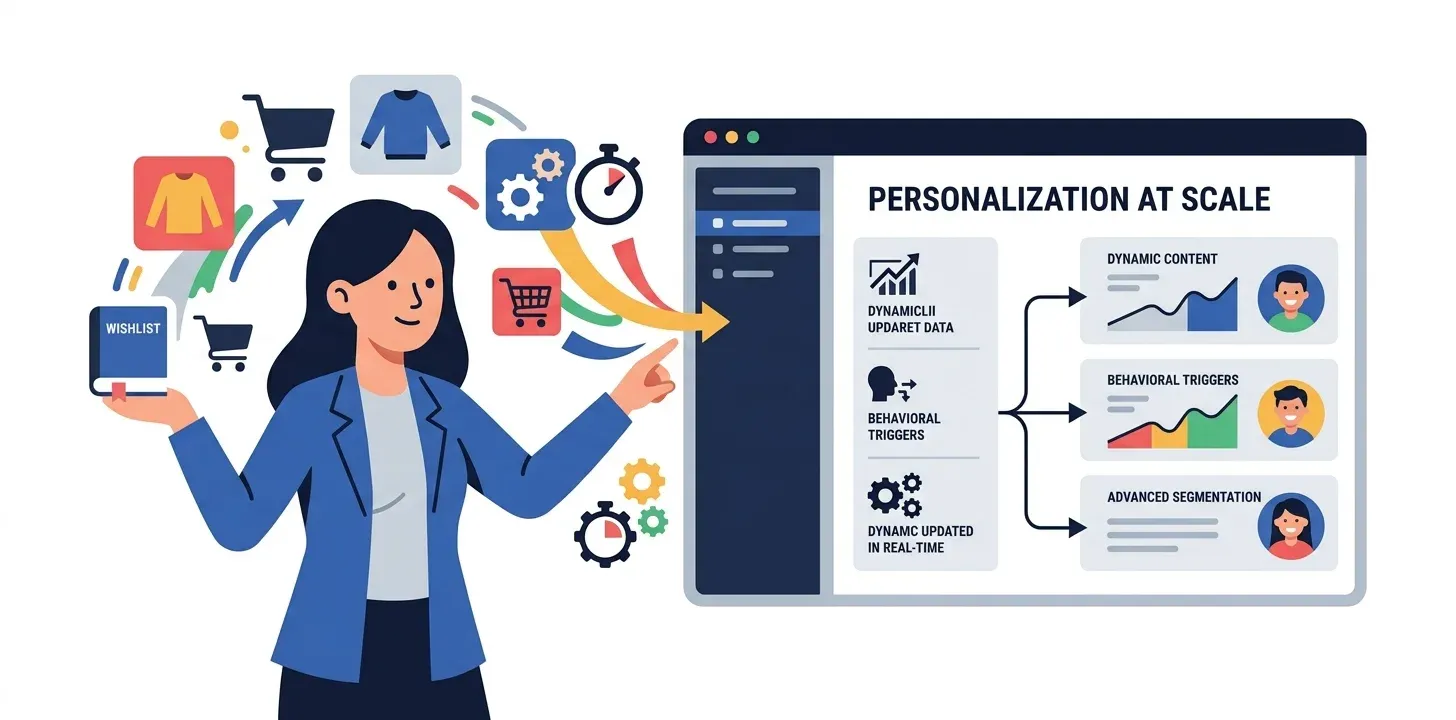
Dynamic Content for Engagement
Marketing automation basics matter because personalization only works when the system knows who it is talking to. Brands like Shein use segmentation to surface relevant products, while Amazon adjusts suggestions in real time to increase cross-sell opportunities and average order value.
Start with first-party data you already trust: demographics, purchase history, browsing activity, and lifecycle stage. Then build a few meaningful segments instead of dozens of thin ones. That gives your team clearer testing conditions and gives buyers messages that feel useful instead of creepy.
Real-time personalization pushes that same logic into the moment. Google Play Books, for example, sends price-drop notifications when items on a wishlist become more attractive. The message lands because the timing matches existing intent.
Adobe's latest research on personalization at scale makes the broader point well. Better ROI comes from connecting quality data, cross-functional alignment, and the touchpoints where relevance actually changes behavior.
Behavioral Triggers for Relevance
Behavioral triggers are some of the safest, highest-return automations you can launch. A visit to a pricing page, a cart abandonment event, or a post-purchase milestone tells you more than a generic list membership ever will.
That is why modern platforms emphasize behavior-based automated workflows. They respond to real actions, refresh targeting as people move, and reduce the lag between intent and follow-up.
Abandoned cart emails work best when they reflect the exact product left behind, the clearest value proposition, and a direct next step. Including the shopper's name, the abandoned item, and a clean CTA usually beats a generic reminder sent hours later.
Post-purchase follow-ups deserve the same care. A thank-you note, setup guidance, or a recommendation for a complementary product can increase repeat purchases without feeling pushy because the message matches what the customer just did.
Advanced Segmentation Techniques
Segmentation gets stronger when you combine fit and intent. Demographics, company size, geography, and purchase history tell you who the buyer is. Behavior tells you how ready they are to act.
That mix makes targeting more precise and budgets easier to defend. Instead of broadcasting one message to everyone, you can prioritize the segments most likely to convert, retain, or expand.
Static lists age badly. Dynamic segments update as buyers download content, revisit high-intent pages, or shift product interest, which keeps campaigns relevant without forcing manual cleanup every week.
Used well, automated segmentation improves resource allocation, lead quality, and brand loyalty. It also keeps personalization honest because the segment reflects current behavior, not last quarter's spreadsheet.
Lead Scoring and Nurturing
Optimizing Lead Scoring Models
Predictive lead scoring improves prioritization because it learns from conversion history instead of relying only on gut feel. That matters in B2B programs, where the highest-value account is not always the loudest individual lead.
Good models also stay close to sales reality. Adobe's lead scoring guidance recommends treating scores as signals of sales readiness, then refining them as new data arrives. Dynamic scoring keeps the model useful when buyer behavior changes.
Behavioral data shows intent in motion. Website visits, repeat pricing-page views, content downloads, email clicks, and event attendance help teams spot who is researching seriously and who is only browsing.
Use those signals alongside fit criteria like role, industry, and company size. A lead who matches your ideal customer profile and keeps taking high-intent actions deserves faster follow-up, cleaner routing, and clearer ownership between marketing and sales.
The same logic applies to influencer programs. Teams using Scrumball can sort creators by brand fit, engagement quality, outreach stage, and live campaign performance, which makes the next action easier to prioritize.
Automated Nurture Campaigns
Nurture sequences work when each message earns the next one. Education first, proof second, and a stronger conversion ask once the buyer has context. That rhythm keeps the sequence helpful instead of feeling like a countdown clock.
HubSpot's guidance on lead nurturing workflows is useful here: start with welcome emails, build education-based sequences, and layer in lead scoring once the early journey is stable.
Behavior-based personalization makes nurture faster and more believable. If a prospect keeps returning to one product page, the next email should answer the objections around that offer, not restart the whole brand story.
Marketing automation platforms help teams operationalize that logic with triggers, segmentation, and content branching. Done well, the result is simple: more trust, better timing, and less wasted outreach.
Aligning Sales and Marketing
Shared lead data turns nurturing into a revenue process instead of a marketing-only exercise. When both teams see the same engagement history, lead score, and campaign context, handoffs get faster and follow-up gets more relevant.
Adobe highlights this clearly in its guidance on aligning marketing and sales teams. Unified data and real-time profiles help both teams work from the same picture of buyer readiness.
Alerts are a small workflow with outsized value. When a lead hits a score threshold, requests a demo, or returns to a buying page, the right rep should know immediately.
That speed protects pipeline. It reduces missed opportunities, shortens response time, and keeps high-intent leads from cooling off while teams debate who owns the next step.
Multi-Channel Marketing Automation Strategies
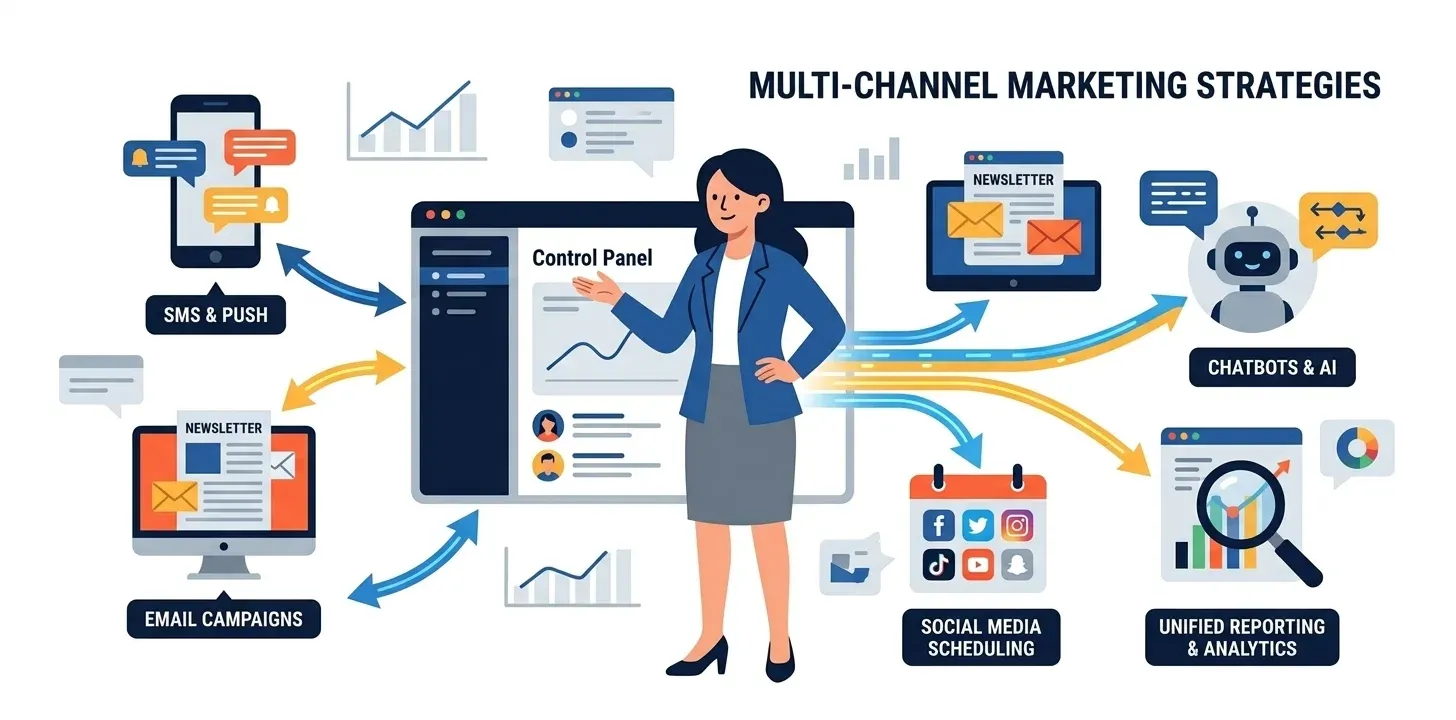
Email Campaign Automation
Email still earns its place because it is measurable, flexible, and easy to personalize. The catch is that consistency matters more than volume. A clean welcome flow, onboarding sequence, and re-engagement program usually outperform random one-off sends.
Marketing automation platforms make that consistency easier by handling segmentation, scheduling, and triggers in one place. Teams should still test subject lines, offers, and CTAs before assuming the workflow is finished.
Email becomes more effective when it works with the rest of the journey. A prospect might discover you on social, click through an email, chat with a bot, and later convert through SMS or a sales call. The automation should connect those moments.
Braze's guide to cross-channel customer journeys makes a practical recommendation: start with a few high-impact journeys that are easy to measure, then expand once the coordination is working.
| Benefit | Description |
|---|---|
| Increased Reach | Integrating email with social, paid media, and content helps your brand stay visible across more touchpoints. |
| Enhanced Customer Engagement | Consistent messaging across channels creates a more coherent experience and gives buyers more ways to respond. |
| Improved Conversion Rates | Personalized messages across channels reinforce the offer and increase the likelihood of action. |
| Better Tracking and Analytics | Shared reporting helps teams see which channel combinations move pipeline, not just which one got the last click. |
| Cost-Effective | Reusing creative and data across channels extends reach without multiplying manual work. |
Social Media and Chatbots
Social media automation should remove repetitive work, not erase the human voice. Teams often use tools like Hootsuite, Buffer, or Sprout Social to schedule content, monitor replies, and keep brand activity visible between larger campaigns.
Sprout Social's social media automation documentation shows the most useful layer beyond scheduling: automated inbox rules, message prioritization, and chatbot workflows that route conversations without losing context.
Chatbots are valuable when speed matters more than polish. They can answer simple questions, route conversations, and support live agents with context while the buyer is still engaged.
- Conversational AI can provide 24/7 support, personalized guidance, and faster issue resolution.
- Virtual agents can simulate human-like interactions for routine requests across web and messaging channels.
- Agent-assist bots can surface suggested replies and relevant information while support teams stay in control.
These tools work best when the handoff is clear. If the bot cannot resolve the issue, it should pass the conversation to a person with the right context already attached.
SMS and Push Notifications
SMS and push notifications are built for timing. Appointment reminders, flash sale alerts, shipping updates, and renewal prompts land well because the message is short, specific, and tied to an immediate next step.
Combining SMS with email or social media gives you both speed and depth. SMS handles urgency. Email carries detail. Social reinforces the campaign visually and keeps the audience warm between direct messages.
AI and Predictive Analytics for Improving ROI
AI-Driven Campaign Enhancements
AI helps most when it removes manual analysis and surfaces the next adjustment faster. That might mean creative suggestions, better pacing insights, or tighter controls over where campaigns appear.
- Google Ads added reference-image support so teams can guide AI-generated visuals toward brand-safe creative.
- The same update introduced campaign-level negative keywords for Performance Max, giving marketers tighter control over relevance.
- Creative reporting and asset coverage recommendations make it easier to spot weak assets before budget leaks into underperforming combinations.
These features do not replace strategy. They shorten the time between seeing performance drift and making a smarter decision, which is where AI can have an immediate effect on ROI.
A/B testing is still the discipline behind the hype. What changes with AI is speed. Teams can generate more test ideas, create variations faster, and identify winning patterns without treating every experiment like a one-off project.
Optimizely's AI-driven experimentation guidance captures the opportunity well: use experimentation to tie changes back to conversion, retention, and other business outcomes rather than relying on opinions or vanity metrics.
Predictive Analytics for Maximizing ROI
Predictive analytics helps marketing focus on the people and accounts most likely to buy. In B2B programs, that means looking beyond a single contact and asking whether the whole account shows the right mix of fit, timing, and intent.
Adobe's predictive lead and account scoring documentation is a useful model. It scores people and accounts, surfaces influential factors, and helps marketers refine segments instead of guessing who should move first.
Forecasting is what turns analytics into spending decisions. If you can see which channels, segments, and journeys are likely to create incremental revenue, you can shift budget before the quarter closes.
Salesforce's guide to marketing ROI analysis makes that point directly: clear ROI measurement helps teams identify the most profitable channels and reallocate spend with more confidence.
Conversational AI and Chatbots
Conversational AI improves the customer experience when it handles common requests instantly and hands off complex cases gracefully. That reduces wait times, keeps support available around the clock, and lets human teams focus on work that needs judgment.
Intercom reports that 81% of support leaders believe automated support tools improve employee experience and reduce attrition. That matters because better internal efficiency often shows up in customer satisfaction and operating cost, not just headcount savings.
AI-supported qualification works best when it enriches, prioritizes, and routes leads instead of pretending to close the whole sale. The win is faster focus, not magic.
Used that way, AI helps sales teams spend more time on high-potential buyers and less time triaging noisy inbound interest. That is a practical, durable path to better results with the same team.
Performance Tracking and Continuous Optimization
Key Metrics for ROI Improvement
ROI gets clearer when you watch revenue-facing metrics, not just opens and impressions. Conversion rate shows whether the journey is moving buyers forward. Customer lifetime value shows whether those gains hold after the first sale.
Braze recommends tracking conversion rate by journey stage, retention, lifetime value, and hours saved. That mix keeps reporting tied to business impact while still showing whether automation is reducing manual work.
| KPI | Description |
|---|---|
| Conversion Rates | Measure the percentage of leads or users who complete the next high-value action. |
| Customer Lifetime Value | Estimates the total revenue a customer generates across the full relationship. |
| Email Open Rates | Shows whether subject lines and timing are strong enough to earn attention. |
| Lead Generation Metrics | Track lead volume, quality, and progression through the funnel. |
Updated benchmarks still matter here. Businesses using marketing automation often report an average ROI of $5.44 per dollar spent, under-six-month payback, and revenue growth of around 34% when programs are implemented well.
Automated reporting only helps if it answers a decision. Set clear goals, define the KPIs that matter, and build simple dashboards people will actually check. Clean data, role-based views, and consistent definitions do more for adoption than flashy charts.
Campaign Optimization Techniques
Optimization starts with triage. Which campaigns have low conversion rates, weak response by segment, or too many manual fixes? Those are the places where automation should expose friction before spending keeps compounding.
Regular reviews keep workflows healthy. Check triggers, suppressions, content freshness, and handoff rules. Small issues, like a stale segment or broken branch, can quietly flatten results for months.
Data-driven improvement is usually less dramatic than teams expect. Often it is a sharper message, a cleaner segment, or a better-timed follow-up. That is exactly why it compounds.
GoSquared's example of Simplero refining its messaging after customer research is a good reminder. Clearer positioning can improve engagement before you add another workflow.
Integrating Analytics with Automation
Analytics become more useful when they are connected to the systems sending messages, scoring leads, and tracking revenue. Otherwise, teams spend more time reconciling reports than improving campaigns.
The CMO's guide to marketing integrations highlights the practical upside: shared data, fewer manual errors, and clearer visibility into performance across channels and platforms.
| Benefit | Description |
|---|---|
| Improve workflows and processes | Automates data sharing so teams spend less time on exports and manual reconciliation. |
| Maximize your martech stack | Connects systems for a broader view of campaign performance and customer behavior. |
| Identify areas for improvement | Shows which channels, assets, or handoffs need attention. |
| Track key metrics | Enables consistent monitoring across the programs that influence pipeline and revenue. |
Real examples make this easier to trust. Salespanel notes that EasyJet's personalized anniversary emails drove open rates more than 100% higher than typical newsletters and lifted click-through rates by 25%. The same article points to Sephora's use of customer data for tailored recommendations.
That is the larger lesson. Automation improves ROI when insights loop back into messaging, timing, segmentation, and spend. When the loop breaks, automation becomes a delivery engine. When it stays closed, it becomes a growth system.
Summary
Advanced marketing automation works best when it feels boring behind the scenes and personal in the buyer journey. The workflows run cleanly. The data stays current. The team knows which metrics matter and which steps deserve a human touch.
Use automation to remove repetitive work, not to replace judgment. That is usually the difference between a program that looks efficient and one that actually improves ROI.
If your automation mix includes creator partnerships, the same discipline applies. Scrumball brings discovery, outreach, approvals, performance tracking, and payouts into one workflow, which makes attribution and ROI reporting easier to manage.
FAQ
What is marketing automation, and why is it important?
Marketing automation is software that handles repetitive work like email sequences, lead routing, segmentation, scoring, and reporting.
It matters because it helps teams respond faster, stay consistent across channels, and personalize at scale. The real gain is not more messages. It is more relevant communication and more time for strategy.
How can marketing automation improve ROI?
Marketing automation improves ROI by reducing manual work, improving timing, and focusing teams on the leads and journeys most likely to convert.
Better segmentation, stronger nurture flows, and faster sales handoffs usually create the biggest gains. Track revenue lift, conversion rate, lifetime value, and time saved so the return is visible.
What tools are best for marketing automation?
The best tool depends on your business model, team size, and channel mix.
B2B teams often need strong CRM integration, lead scoring, and reporting. E-commerce teams may care more about lifecycle journeys, SMS, and recommendations. Start with the platform that fits today's workflows, then scale into AI and multichannel features.
How do I start with marketing automation?
Start with one or two high-impact workflows you can measure clearly, such as a welcome sequence, lead nurture program, demo follow-up, or cart recovery flow.
Clean your data before launch, define ownership with sales or support, and set baseline metrics. Once one workflow is stable, expand into scoring, reporting, and cross-channel coordination.
Can small businesses benefit from marketing automation?
Yes. Small businesses often feel the time savings fastest because manual follow-up eats so much of the day.
Automation helps smaller teams stay consistent, nurture leads, and keep communication from slipping through the cracks. Start small, keep the workflow simple, and avoid paying for enterprise complexity before you need it.